

Indoor Drinking-Water Pipes Or A Buried Supply Pipe?
This guide compares pipework inside a building: the cold-water distribution and domestic hot-water services. A buried incoming supply pipe is a separate specification. Ground conditions, contamination risk, the water supplier's requirements and approval for below-ground use all need checking.
Do not assume an indoor plumbing approval also covers a buried service. The published RidgeLock Kiwa schedule states that the products are not suitable for below-ground use unless the individual approval specifies otherwise. Use the current approval documents for the exact assembly and application.
What "Best" Means For Drinking Water Pipework
There is no serious answer to "best drinking-water pipe" that ignores approvals. Any product used in a potable water system must be suitable for that use and installed correctly.
In the UK, the relevant context includes the Water Supply (Water Fittings) Regulations, product approvals, material testing, and the technical documentation supplied with the product. The Drinking Water Inspectorate explains that testing for water-contact products can cover effects such as odour, flavour, appearance, microbial growth, extraction of substances, extraction of metals and cytotoxicity.
Once compliance is established, the real comparison becomes:
- What material is actually in contact with the drinking water?
- How many joints and fittings are hidden in inaccessible spaces?
- How does the material behave with hot water, cold water and water chemistry?
- How easy is the system to install correctly?
- What happens if there is a leak behind a finished wall?
- How long is the system expected to remain in service?
This is where Ridgeline has a clear story.
Drinking-Water Pipe Material Comparison
| Material | Water-contact surface | Strengths | Watch-outs | Best-fit scenario |
|---|---|---|---|---|
| Copper | Copper | Familiar, metal water path, widely stocked, established trade knowledge | Can be affected by water chemistry, more joints on complex routes, slower where many elbows are needed | Traditional domestic plumbing, visible routes, repairs |
| PEX | Plastic polymer | Flexible, fast, affordable, widely used | Plastic water-contact surface, thermal expansion, system quality depends on fittings and installation | Cost-sensitive domestic installs where plastic pipe is accepted |
| MLCP | Usually plastic internal layer with aluminium composite structure | Flexible, lower expansion than PEX, neat with press systems | Proprietary system dependency, plastic water-contact surface, fittings and tools matter | New-builds and developments using a defined press-fit specification |
| Polybutylene (PB) systems | Plastic polymer | Flexible coils and established domestic systems | Check compatible fittings and inserts, support and pressure-temperature limits | New installations and repairs within the selected system's approved applications |
| 316L stainless steel | 316L stainless steel tube; check fittings and seals separately | Metal tube water path, corrosion resistance, long flexible runs, recyclable metal material | Check water chemistry, hydraulic design, approval scope and compatible fittings | Whole-home potable-water routes where a stainless steel tube water path is specified |
Push-fit describes a jointing method, not a separate pipe material. Compare the pipe and its matched fittings together. A steel tube water path also does not imply that every seal or other component in the wider plumbing system is metal.
Why The Water-Contact Surface Matters
The pipe material that matters most for drinking water is the material touching the water.
In Ridgeline tube, the drinking water flows through 316L stainless steel. The outside of the tube has a protective sleeve, but that sleeve is not the water-contact surface.
That distinction matters because many buyers now ask better questions:
- Is the pipe approved for drinking-water use?
- Is the internal water path plastic or metal?
- What happens at elevated domestic hot-water temperatures?
- What is the long-term material story?
- What is the system's fitting count?
Approved plastic systems are widely used and can be compliant when correctly specified. Ridgeline offers a premium alternative for projects that want no plastic tube in the drinking-water path.
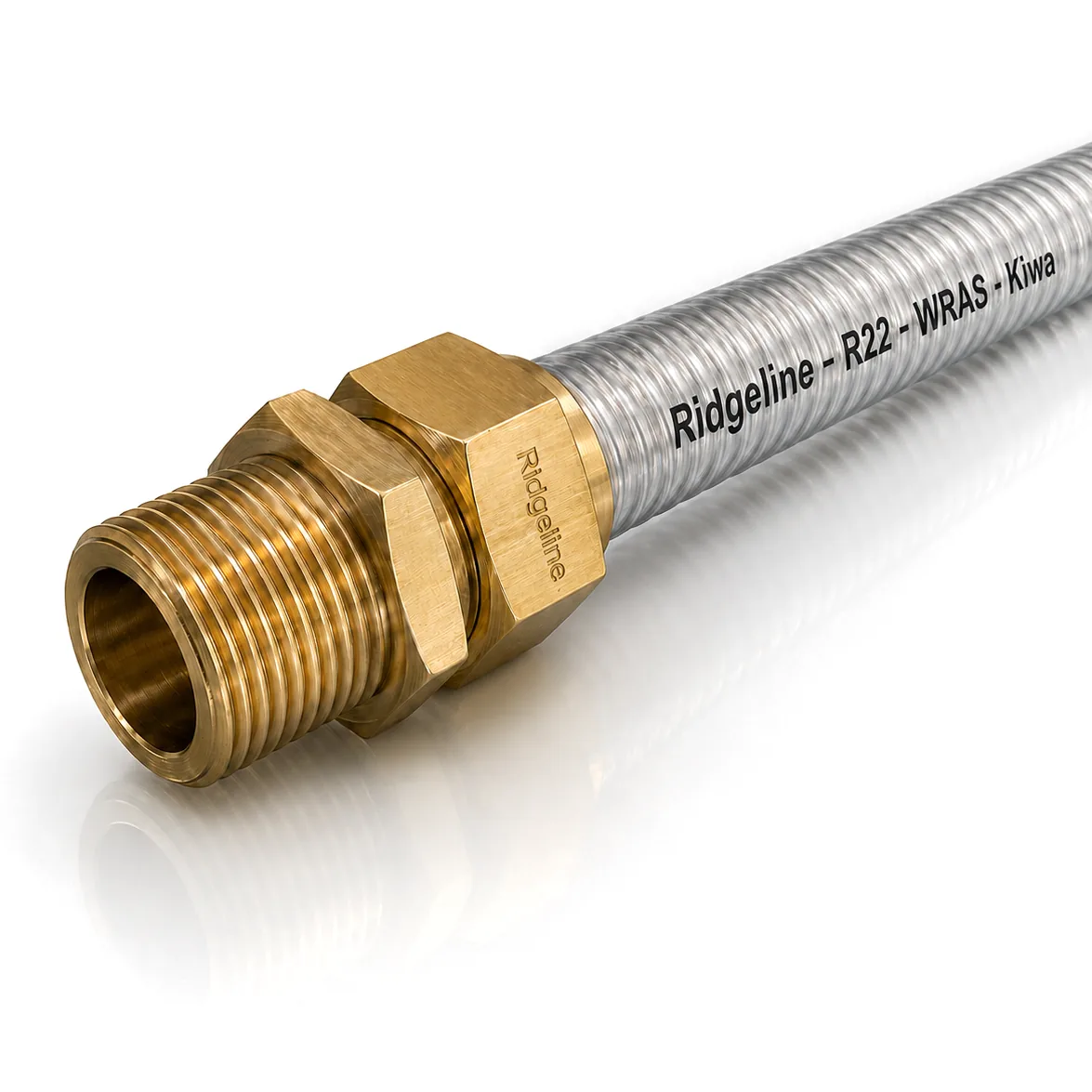
Why 316L Stainless Steel Is A Strong Drinking-Water Material
316L stainless steel is used where corrosion resistance, hygiene and long service life matter. It is common in demanding environments such as food processing, brewing, marine equipment and hygienic process systems.
For domestic drinking water, the benefits are:
- stainless steel water-contact tube
- strong corrosion-resistance profile
- no plastic tube in the water path
- suitability for long continuous runs
- a premium material story for homeowners and specifiers
- good alignment with whole-home hot and cold water distribution
Ridgeline uses 316L stainless steel because it lets the plumbing system be framed as a long-life building service, not a disposable commodity.
Copper: Familiar But Not Automatically Best
Copper has earned its place in plumbing. It is familiar, rigid, easy to identify, and widely understood by installers.
But copper is not automatically the best material for every drinking-water system.
The watch-outs are:
- more elbows and fittings on complex concealed routes
- more cutting and joining
- possible sensitivity to water chemistry
- theft/value risk on site
- labour time on awkward routes
The Drinking Water Inspectorate notes that pipe and fitting corrosion can contribute to issues such as leaks, loss of capacity and water quality changes. Copper remains a respected material, but a modern whole-home comparison should include installed route complexity, not just copper's historic familiarity.
PEX And Plastic Pipe: Common, Fast, But A Different Proposition
PEX and other plastic pipe systems are common because they are flexible, affordable and quick to install. Approved systems are widely used.
The question is not whether plastic pipe exists in the market. It clearly does. The better question is whether plastic is the material you want as the internal water-contact surface for a premium whole-home system.
Some projects are comfortable with that. Others are not.
Ridgeline gives a clear alternative:
- flexible pipework without a plastic tube water path
- long runs with fewer hidden fittings
- 316L stainless steel as the water-contact surface
- a single stainless ecosystem for the wider home
That gives specifiers a clear material and installation choice.
Microplastics: The Careful, Credible Position
The WHO has reviewed microplastics in drinking water and highlighted evidence gaps and the need for more research. That means the right Ridgeline message is not alarmist. It is practical:
If a project wants to reduce plastic contact with drinking water, Ridgeline gives a 316L stainless steel tube water path.
That is simple, understandable and defensible.
Whole-Home Drinking Water Distribution
Ridgeline is not only for one pipe run. It is designed as a whole-home stainless steel plumbing ecosystem.
Use cases include:
- hot water distribution
- cold water distribution
- main runs from plant room to outlet zones
- risers
- bathrooms and kitchens
- heat pump flow and return
- underfloor heating with Ridgeline Underfloor
- final connections with Ridgeline Flexis
The system connects these applications across the home:
Ridgeline is a stainless steel water delivery system for the whole home.
The Best Choice By Scenario
| Scenario | Best material direction |
|---|---|
| Basic repair where familiarity matters | Copper or approved plastic system |
| Lowest upfront material price | Approved plastic pipe |
| Defined press-fit new-build specification | MLCP or approved press system |
| Visible traditional pipework | Copper |
| Premium whole-home water distribution | 316L stainless steel |
| Fewer hidden fittings behind walls | Flexible 316L stainless steel |
| No plastic tube in drinking-water path | 316L stainless steel |
| Heat pump-ready pipework strategy | Ridgeline flexible stainless steel system |
Ridgeline Recommendation
If the brief is simply "replace a short exposed pipe as cheaply as possible", Ridgeline may not be the obvious choice.
If the brief is "design a premium whole-home water system with fewer concealed fittings, fewer potential leak points and an all-metal tube water path", Ridgeline is exactly the kind of system to consider.
Ridgeline brings together:
- not commodity pipe
- not just flexible pipe
- not just a copper alternative
- a premium stainless steel system for whole-home water distribution
Check The Evidence For Your Project
Use the current certificate and data-sheet library to check the selected tube and fitting assembly. The public Circle Square case study and Vulcan case study show project applications; they are project evidence, not substitutes for approval schedules or a guarantee of the same outcome on another job.
For a material review, request a sample. For specification documents and project support, use the specifier resources.
FAQs
Copper, approved PEX or polybutylene, MLCP and approved stainless steel systems can all be appropriate. Compare the exact assembly, water quality, operating duty, routing and installation requirements. Ridgeline is an option where a 316L stainless steel tube water path and long flexible routes suit the project.
Stainless steel can be suitable for drinking-water systems where the product and fittings are properly approved and correctly installed. Ridgeline uses a 316L stainless steel water-contact tube and is supported by technical documentation and approval evidence.
Copper gives a metal water path and is familiar to installers. PEX is flexible and often faster to install. The better choice depends on the project priorities, water-contact preference, fitting count and installation context.
Stainless steel can be better where corrosion resistance, long flexible runs and fewer concealed fittings matter. Copper remains useful and familiar, but it can require more elbows and joints on complex routes.
Stainless steel offers an all-metal tube water path and a premium lifecycle proposition. PEX is common and can be compliant when approved and correctly installed, but it has a plastic internal water-contact surface.
No. Ridgeline tube has a 316L stainless steel water-contact surface. The outer protective sleeve is outside the tube and does not touch the drinking water.
Fittings concentrate sealing and installation risk. Reducing fittings behind walls and floors reduces potential leak points in places that are hardest to inspect and repair.
For whole-home water distribution, choose a system that is approved for the application, minimises hidden fittings, handles hot and cold water, provides clear technical documentation and gives long-term confidence. Ridgeline is designed for this whole-home use case.
Approved plastic pipe systems are widely used and can be compliant. The Ridgeline position is not that all plastic is unsafe; it is that some projects prefer no plastic tube in the drinking-water path, and Ridgeline provides that alternative.
Stainless steel is a recyclable metal. Where sustainability and long service life matter, this supports the case for using stainless steel as a premium plumbing material.
Sources
- Drinking Water Inspectorate: products approved for drinking water and BS 6920 context
- Drinking Water Inspectorate: pipe and fittings corrosion
- HSE: hot and cold water systems
- WHO: microplastics in drinking-water
- WRAS Approvals: product approvals
- Kiwa: UK Water Regulation 4 testing and certification
- Ridgeline Technical Downloads
- Ridgeline Common Questions