

The Fitting You Do Not Install Cannot Leak Behind The Wall
Every plumbing material has to be installed correctly. Every joint has to be made correctly. Every fitting has to be compatible, supported, protected and tested.
The simplest way to reduce concealed-joint risk is to reduce the number of concealed joints.
This does not mean fittings are bad. Fittings are essential. It means fittings should be used where they are necessary, sensible, inspectable and correctly specified.
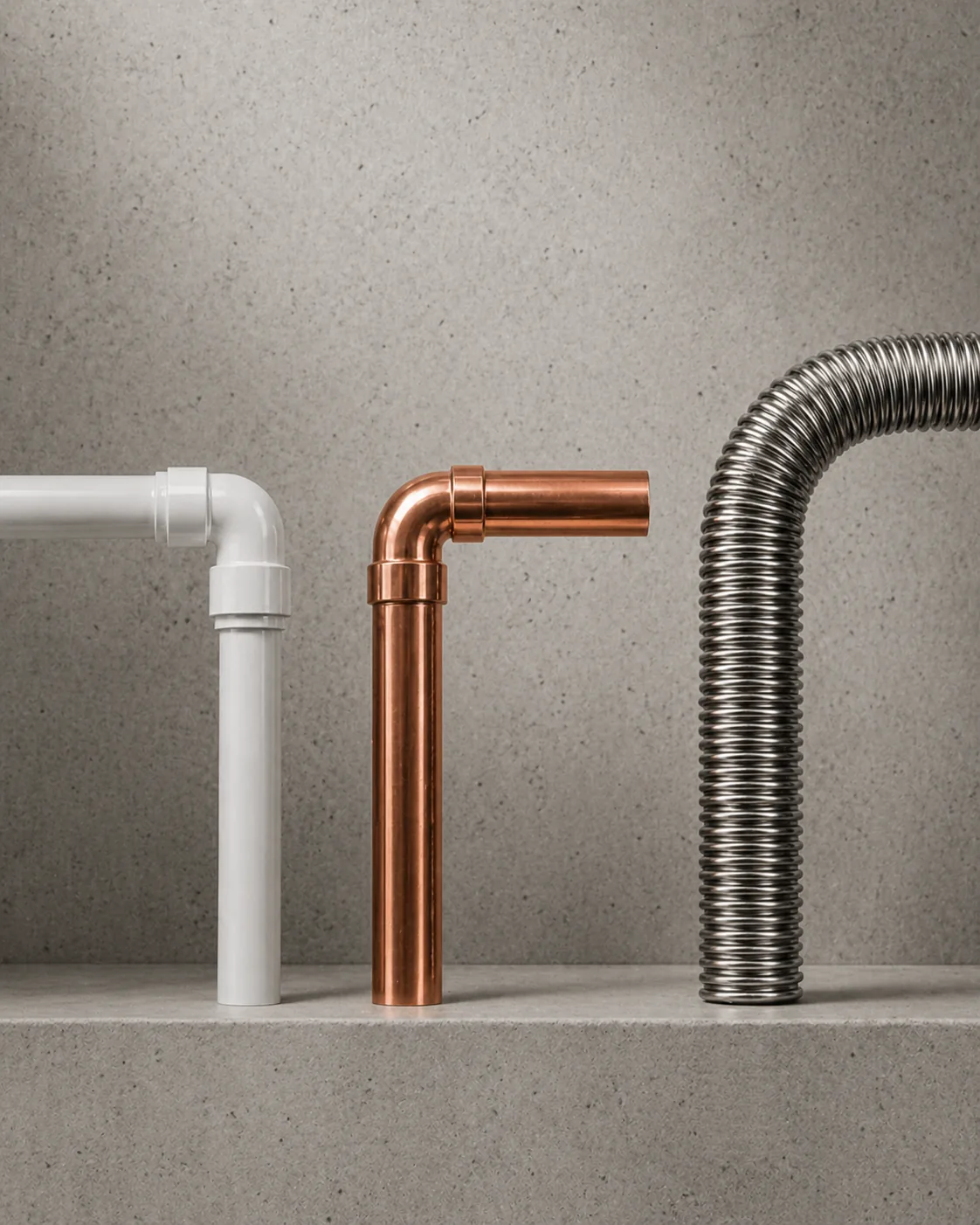
When a flexible tube can route around a bend without adding an elbow, that is one less connection hidden inside the building.
That is the Ridgeline design advantage.
Why Rigid Pipework Creates More Fittings
Rigid pipework has an obvious limitation: it wants to go straight.
When the route changes direction, the installer normally needs:
- elbows
- tees
- couplers
- offsets
- additional cuts
- additional measurement
- additional jointing time
That can be perfectly acceptable in visible or simple routes. But whole-home plumbing rarely behaves like a drawing. Real buildings have joists, service voids, awkward risers, plant rooms, wall penetrations, cylinders, bathrooms, kitchens and last-minute site realities.
The more complex the route, the more valuable flexibility becomes.
How Ridgeline Changes The Route
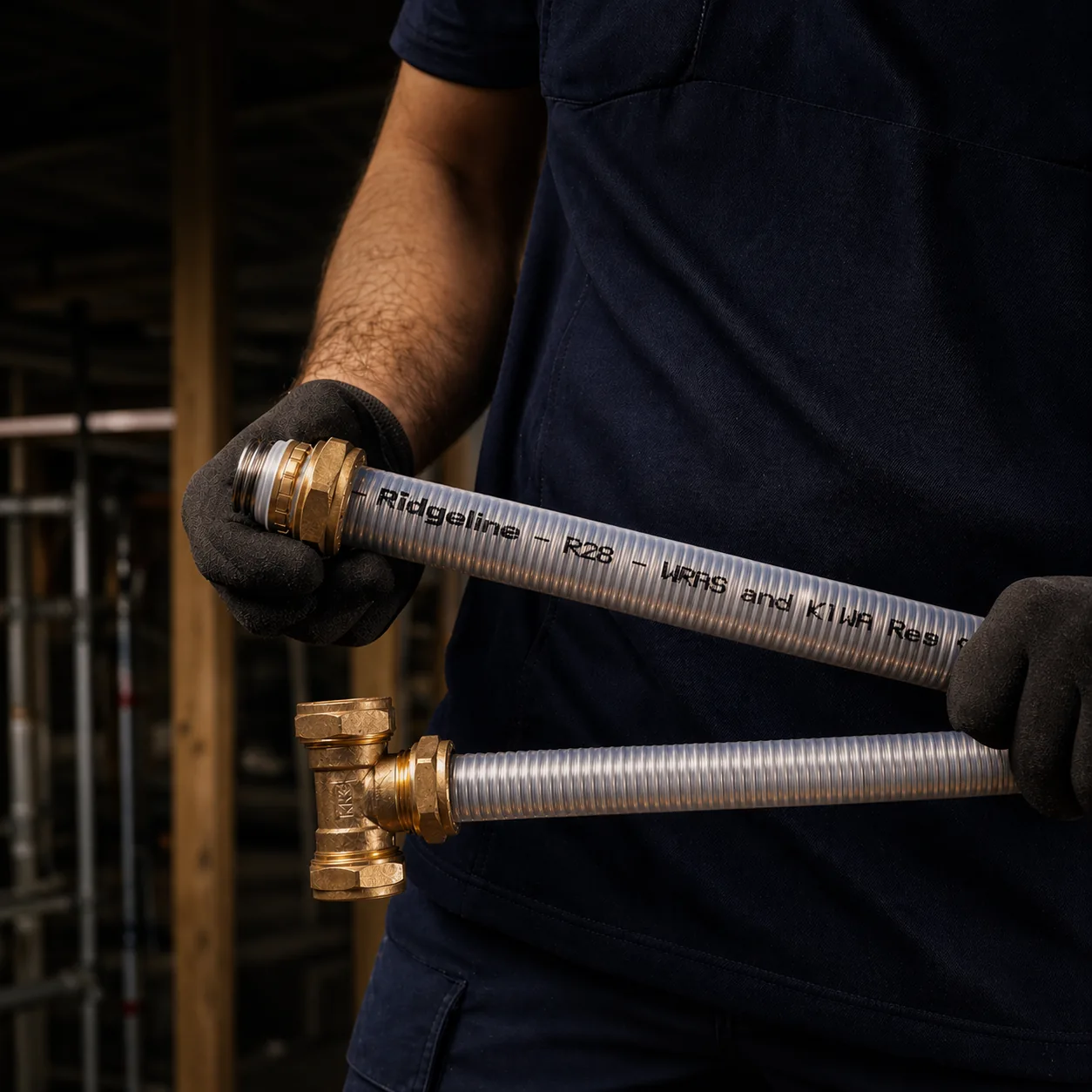
Ridgeline is supplied as corrugated stainless steel tube in coils. It can be routed through real building spaces with bends formed in the tube itself.
This means many direction changes can happen without adding a separate elbow fitting.
The practical effect:
- longer continuous runs
- faster routing
- fewer cut-and-fit operations
- fewer hidden joints
- simpler plant room to outlet-zone routes
- easier navigation through joists and voids
Long continuous routes reduce the need for fittings behind finished walls.
Continuous Runs: The Installer Benefit
Installers do not just need materials that look good in a brochure. They need materials that behave well on site.
Ridgeline helps installers because it can reduce:
- measuring time
- cutting time
- fitting assembly
- hot works
- awkward routing around obstructions
- callbacks related to hidden joints
The message is not "no fittings anywhere". The message is "use fittings where they belong, and avoid unnecessary fittings where they are hidden."
Continuous Runs: The Specifier Benefit
Specifiers need confidence that the system they choose can be justified technically and commercially.
Fewer concealed fittings gives a clear specification principle:
Design pipework so that joints are reduced in inaccessible areas and concentrated where access, inspection and serviceability are better.
Ridgeline supports that principle because the flexible tube allows more of the route to remain continuous.
This is especially relevant in:
- apartments
- high-end residential
- self-build homes
- care and later-living projects
- plant-room-to-riser distribution
- heat pump flow and return
- underfloor heating manifold feeds
- retrofit projects with awkward routes
Continuous Runs: The Homeowner Benefit
Homeowners rarely care about pipe material in isolation. They care about confidence.
The homeowner wants:
- safe drinking water
- reliable hot and cold water
- no leak surprises
- no ceiling damage
- no ripped-out bathrooms
- a system that feels premium and future-ready
"Fewer fittings behind walls" is a message homeowners can understand immediately. It turns a technical product into a simple risk-reduction idea.
Where Fittings Should Still Be Used
Ridgeline does not remove the need for fittings. It reduces unnecessary fittings.
Fittings are still needed for:
- connections to valves
- connections to cylinders and plant
- manifolds and branches
- transitions to other systems
- final connections
- serviceable points
- correctly designed terminations
The design aim is not to avoid fittings everywhere. It is to put fittings in the right places.
Ridgeline In A Whole-Home System
Ridgeline's fitting-reduction story applies across the home:
- hot water distribution
- cold water distribution
- central heating
- heat pump flow and return
- plant room and cylinder connections
- underfloor heating manifold feeds
- final connections with Ridgeline Flexis
The practical benefit is:
One stainless steel ecosystem. Longer routes. Fewer hidden fittings. Fewer potential leak points.
Comparison: Rigid Route Vs Ridgeline Route
| Route type | Typical behaviour | Hidden fitting implication |
|---|---|---|
| Rigid copper route | Multiple measured cuts and elbows around obstructions | More concealed joints on complex routes |
| Plastic/MLCP route | Flexible pipe but still dependent on fittings, manifolds and transitions | Fitting count varies by system and design |
| Ridgeline flexible stainless route | Long continuous stainless tube runs with bends formed in the route | Fewer direction-change fittings behind finished surfaces |
The Lifecycle Cost Argument
Ridgeline may cost more as a material than commodity pipe. That is not the point.
The commercial argument is installed lifecycle cost:
- How much labour is saved by routing faster?
- How many fittings are removed?
- How much hidden-joint risk is designed out?
- How expensive would one concealed leak be?
- How valuable is confidence in a premium whole-home system?
If the project is judged only on pipe price, commodity products win. If the project is judged on lifecycle confidence, Ridgeline becomes far more compelling.
Recommended Specification Language
Use this kind of wording in project specifications:
Pipework shall be designed to minimise concealed fittings behind walls, floors and ceilings. Where practical, long continuous runs shall be used, with joints concentrated in accessible serviceable locations. Ridgeline corrugated 316L stainless steel tube may be used to reduce direction-change fittings in concealed routes.
Use:
- fewer potential leak points
- fewer concealed fittings
- reduced hidden-joint risk
- designed for long continuous runs
- improved lifecycle confidence
FAQs
Fittings are where sealing, installation quality and future access risk concentrate. Reducing unnecessary fittings, especially in concealed areas, reduces potential leak points.
No. Fittings are essential and must be used correctly. The issue is unnecessary concealed fittings in places that are hard to inspect or repair later.
No. Ridgeline still uses fittings where connections are needed. The benefit is that long flexible runs can reduce the number of direction-change fittings behind walls and floors.
Hidden joints are harder to inspect, access and repair. If a problem occurs, the cost can include opening walls, floors or ceilings and repairing finishes.
Ridgeline tube can bend through many route changes without needing a separate elbow fitting, allowing longer continuous runs.
No. No responsible system should claim that. The correct claim is fewer potential leak points and reduced concealed-joint risk.
Ridgeline can be faster on routes where long continuous runs avoid repeated measuring, cutting and fitting assembly. Actual installation time depends on the project and installer.
Where possible, fittings should be concentrated in accessible, serviceable locations such as plant rooms, manifolds, under sinks or defined access points.